If you use Sage 200 in a manufacturing business, you’ll already know that accounting is only one part of the picture. You’ve also got stock to manage, materials to plan, works orders to keep on top of, production schedules to organise and, somewhere in amongst all of that, customers waiting for their orders.
That’s where CIM200 comes in.
CIM200 is manufacturing software designed specifically to work with Sage 200 Professional. Rather than running your manufacturing processes in a completely separate system, it adds the manufacturing functionality you need around Sage 200, covering everything from stock and Bill of Materials through to planning, production and the shop floor.
Stock control becomes increasingly important as manufacturing gets more complicated. It isn't simply a question of knowing that you have 100 of something in stock. You need to understand what's available, what's already required for production, what's coming in and what you're likely to need next.
CIM200 builds on Sage 200 Stock Control with additional manufacturing information, projected stock levels, quicker stock movement processing and an audit history of changes.
For the people actually planning production, having that information available in the same system can make life considerably easier.
Then we have Bill of Materials, or BOMs. This is where you define what goes into making something, including the components and processes required to produce the finished item. CIM200 supports different manufacturing requirements including multiple routes, percentage based BOMs and kitting. Changes are also audited, so you have a history of what was changed and when.
That becomes particularly useful when products or production methods change over time.
Once something goes into production, you need to know what's happening to it. CIM200 Works Orders lets you follow items through the manufacturing process, manage material allocations and work in progress, and look at the resources required to meet demand.
You can also compare estimated production costs with what actually happened, including materials, machines, tooling, subcontracting and overhead costs.
That last part can be particularly revealing. Producing something for £100 because that's what you've always assumed it costs isn't quite the same as knowing it costs £100!
This is where MRP, or Material Requirements Planning, comes into play. CIM200 Planning looks at demand coming from areas such as sales orders, works orders, forecasts and stock requirements. It can then identify shortages and help determine what needs to be purchased or manufactured to meet that demand.
The aim is to have the materials you need when you need them, without unnecessarily filling the warehouse with stock you won't use for months.
There is functionality here too.
CIM200 Shop Floor Data Capture uses barcodes to record activity as production takes place. That can include issuing components, viewing job information, recording time against operations and completing works orders.
Because that information is being captured as work happens, the people managing production get a much more current picture of progress.
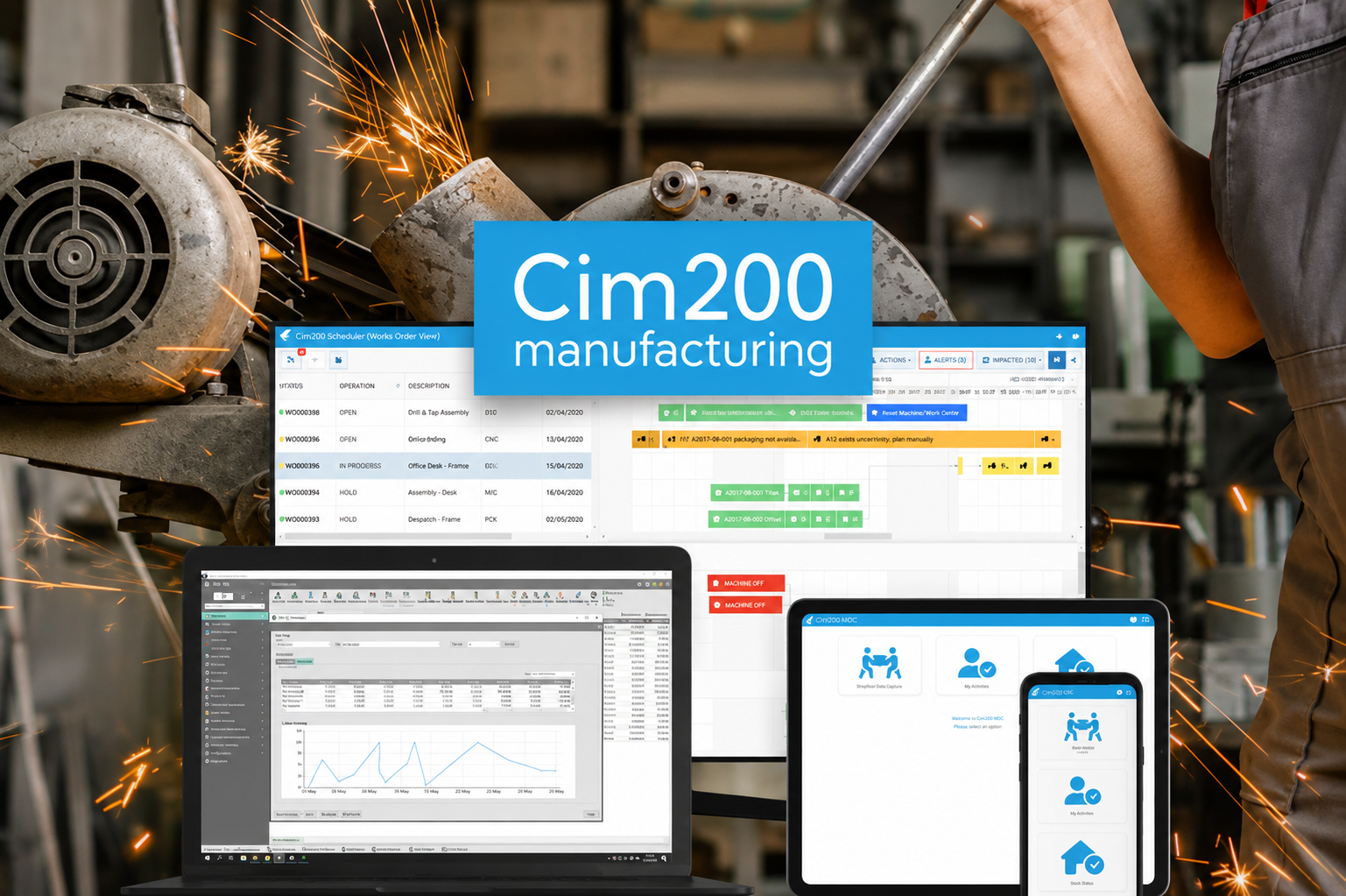
There is also a Graphical Scheduler which gives production teams a visual view of the schedule. You can plan around the capacity and availability of labour and machines, spot potential clashes and adjust the production plan before committing it back into CIM200.
This is an important one.
Sage 200 Manufacturing reached the end of its lifecycle, and official support ended on 31 December 2025. CIM200 was developed as a replacement for businesses wanting to continue using Sage 200 while retaining dedicated manufacturing functionality.
The useful part for existing Sage 200 Manufacturing users is that CIM200 has been designed to look and feel familiar. It integrates with Sage 200 Professional rather than asking your team to learn an entirely unrelated system.
That doesn't mean moving should be treated as a simple software update, though. Your manufacturing system sits at the heart of a lot of business processes, so it's important to understand how you're using the existing system before planning the move.
If manufacturing is a significant part of your operation and Sage 200 is already at the centre of your business, CIM200 gives you a way to bring much more of the manufacturing process into that environment.
But, as always, the software is only part of the conversation.
We'd want to understand how you manufacture, how you currently manage stock and production, what works well and where your team is relying on spreadsheets or manual processes.
If you're already using Sage 200 Manufacturing and aren't sure what the move to CIM200 involves, speak to us. Likewise, if you're using Sage 200 but managing manufacturing elsewhere and wondering whether there's a better way of doing it, we're happy to have a chat.
You don't need to know which CIM200 modules you need before you call us. That's our bit 😊
📞 01954 213999